Due to the emerging
concern about climate change. There is increasing interest in finding
non-polluting, renewable systems to reduce carbon emissions in the
shipping industry. One such proposal is the adoption of wind assistance
systems for ships. The wind, which is present most of the time and
abundant, costs nothing and is just waiting to be employed once again as
it was in history, but now with the benefit of improved technology. If
this can be brought about there are two winners, not only the planet but
also the ship operators who will save fuel and save money.
Some progress is being made, with
many companies proposing, various systems to bring wind assistance to
ships. Some have reached testing stage and others are just proposals.
Here are some of the systems that can be used:
Sails
- These we are most familiar with as sails were used as a power source
to navigate the seas and oceans for hundreds of years. They work well
and have a big tradition behind them. But they have some drawbacks,
chief of which is that they require a lot of manpower to raise, lower,
reef, and adjust at all times.
Wingsails
- A modern version of sails. Since the invention of aircraft, people
have seen the similarity between how an aircraft flies and how sails
work. So vertical wings have been made to replace sails. There are
wingsails that can be lowered and raised like traditional sails, but
they are complex and untidy. The predominant form of wingsail is a rigid
aerofoil which is held at the correct angle of attack to the wind either
by a tail vane or electronic computer control using sensors and servos.
The advantage here is that they don't flap like traditional sails and
they don't require large crews to operate them. There are some
challenges about being able to lower them or not. Some cling to the old
idea that they should be lowered. Others realise that they can be left
up and allowed to weathervane naturally. It is generally believed that
wingsails are more efficient than traditional sails and that is one of
the reasons that they have been adopted in some cases.
Kites
- One of the main advantages of kites is that they do not require very
much modification of the ship, only requiring a hitching point. Another
advantage is that they fly higher than the ship where the winds are
stronger.
Ventifoil
- Based on an original idea by
Jacques Cousteau where it was called "Turbosail" this is a vertical
cylinder into which air sucked in through a lengthwise slot - this gives the cylinder the characteristics of an
aerofoil and provides thrust. At least one company has been doing active
research on these. (Econowind).
Savonius Rotor
- This is the type of vertically
rotating "S" - when seen from above - which is often used for rotating
advertising boards or extractor fans blown round by the wind. These
would need to be linked to an underwater propeller to provide thrust for
the ship. A possible attraction of these is that you would not need to
orient them to the wind as they can respond to the wind coming from any
direction. Not much research has been done on these. Savonius was a
Finnish inventor who first investigated them.
Flettner Rotor
- This is a vertical cylinder mounted on the ship which is rotated by a
motor. When the wind passes over the rotating
cylinder the Magnus Effect causes the cylinder to produce lift in either
direction depending upon the direction of rotation. The unit does not
have to be oriented to the wind and will provide forward thrust from
either side of the ship. At the moment these are the most popular
systems and have been fitted to several different ships. Flettner was
the original experimenter who built a test ship in the 1930s.
Wind Turbines
- These need to be connected to an underwater propeller to help power
the ship. They have been used as the sole source of power on
smaller craft, but could also be used as assistance for engine driven
ships, either using a separate propeller or by feeding power into the
main propeller shaft of the ship.
Unlike the other systems Wind Turbine drive allows the ship to
obtain power from headwinds as well as sidewinds. If anyone is in doubt
about the possibility of this please see
this page where I have assembled some evidence that proves the
possibility.
Below is a polar of the thrust that can be obtained from an average
sailing ship.
The
red
line indicates what direction the ship can sail in relation to the
wind direction.
As can
be seen the fixed sail cannot provide any useful thrust for 45
degrees each side of the wind direction. So the ship will be
pushed backwards if any attempt is made to go in that direction.
The rotary sail system
resists and counteracts the oncoming wind and allows sailing in
the 90 degree area into the wind which with a normal sail is
impossible. It allows the ship to be able to benefit
from useful wind thrust in any direction as opposed to only some
directions which is the case with the other systems.
This polar would also apply
approximately to sails, wingsails, kites, ventifoil and Flettner
rotors. With these systems there is no thrust available when the
wind comes from an angle of approximately 45 degrees each side of the
heading of the ship. A wind turbine system which is described below
uniquely is able to use wind from ahead of the boat. Therefore holds
considerable advantages from the other five assist systems because it
can provide wind assistance at all times.
Rotary
Sail wind turbine system for wind assist
I have
done extensive research using models and fullsize craft to determine
what is the best design of rotary sail for sailing direct to windward.
The type of wind turbine I found best was somewhat different than the
land-based wind turbines for producing electricity.
I found that a
slower rotating turbine was more effective because the lift vector
angle was more favourable.
The angle I used was 45 degrees to the wind when the rotor was
stationary.
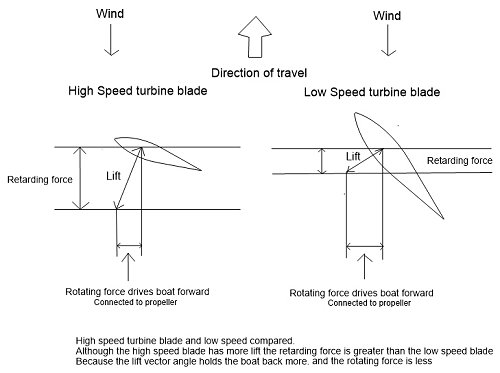
Below is a diagram of the forces involved.
High speed
turbine blade and low speed compared.
Although the high speed blade has more lift. The retarding
force is greater than the low speed blade and the driving force
is less because the lift vector angle holds the boat back.
The increased lift
would be desirable for a land based turbine
which is trying to extract as much power as possible from the wind.
But on a boat which is not fixed to the ground we need to minimise
the unfavourable thrust in the wrong direction.
Many models were
tested. To view them please visit sister site
Sailwings.net
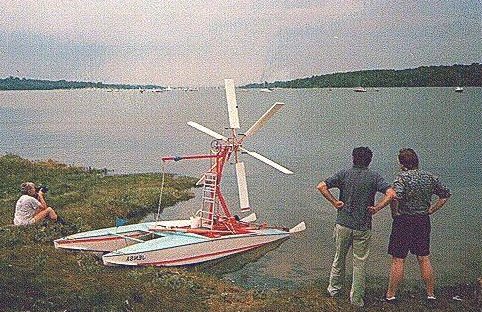
"Jensa" the
Rotary Sail testing boat.
A 12 foot long
catamaran was converted to have a rotary sail.
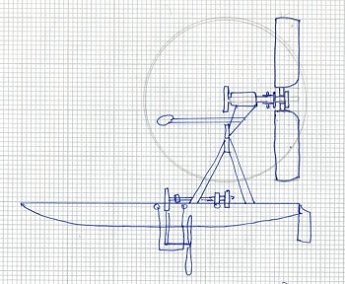
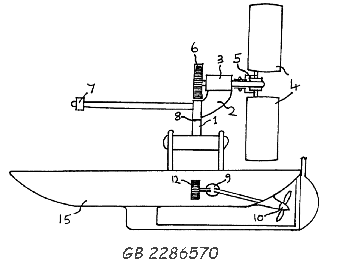
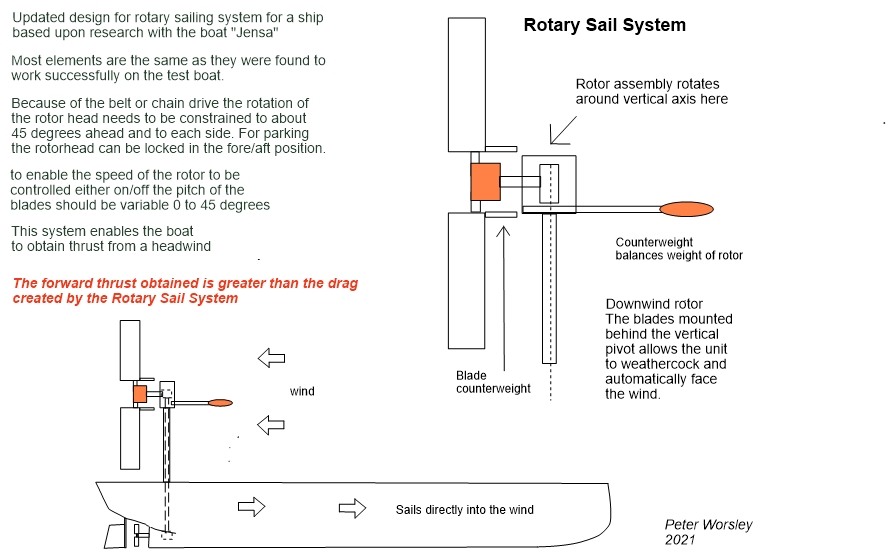
To allow the rotor to align itself to the wind it was mounted behind the
vertical pivot. So the rotor head was allowed to pivot where
it liked, and was counterbalance by a weight on an arm.